Saturday, March 5, 2011

Vietnam: Ho Chi Minh City March 3rd-March 5th

We arrived in the city of nine million, ready to take in the history of the last city to fall to Communists in the war and the headquarters of the American forces.  Our guide Thuy picked us up from the airport and we headed straight to the famous Cu Chi Tunnels just 70 kilometers from central Saigon.  Originally built by the French, the Viet Cong extended the tunnels to 200 kilometers long and added three different levels reaching up to thirty meters underground.  Not only did the engineering amaze me, but the thought of it only a mile and half from an American base of 10,000 soldiers, yet it was never discovered.  Used to shelter themselves from the tons of American bombs, the VC built an immense tunnel complex equipped with camoflauged rolling traps, see saw taps and armpit traps in the ground, all with blood poison to ensure an immediate death.  As we walked into the complex, the guards led us to a video viewing room to watch a fifteen minute Viet Cong video on the “devils from Washington D.C.” and “American serial killers”.  No question, the Cu Chi Tunnels communicated the animosity and disdain towards Americans more than any other site we had visited so far.  We emerged from the viewing room, only to scream seconds later as guards let off pretend land mines to really get the feel for life throughout the war.  Throughout our hour and a half on the complex, I never seemed to get use to the unexpected boom of the land mine—I cannot even imagine living in a state of constant angst at one wrong step ending your life.  After walking through the trap display room, we reached the shooting range where they offer tourists the opportunity to shoot an M-16.  I declined, yet continued to jump every time a shot went off making it clear I was a foreigner.  Locals didn’t flinch as gunfire went off ten feet behind them.  We concluded our time at Cu Chi, walking through the insanely small tunnels many called home.  At one point I had to crawl on my hands and knees, as even leaning over my height was too much to continue.  I left the Cu Chi tunnels with a nauseous feeling in my stomach and a hyper jumpy state, as even a butterfly coming towards my head startled me!  Megan wisely stated that we all needed to get to the hotel ASAP to watch a Disney movie.
After our day excursion we headed into the central of Ho Chi Minh City, which made the traffic in Hanoi look like nothing.  Locals claim that although the city population totals nine million, there seem to be ten million motor bikes on the road at any point.  We reached the Majestic Hotel with stunning views of the Saigon River and a sky bar that provided entertaining aerial views of the insane traffic.  After a powerful school session, we hit the streets for what we do best—shopping and eating.  Shopping stalls with knock off EVERYTHING lines the main drags, including banned books, handbags and sunglasses.   Dinner at Lemongrass proved to be a winner, as fried noodles with Chin Shu spicy chili sauce has turned into my favorite dish!  I walked around the city center checking out the night life scene, which proved to be much more entertaining in the streets than in the bars.
At 10:00 am the following morning, our guide met us in the lobby for a packed day of sight seeing.  Our first stop—the War Crime Museum, originally named the American War Crime Museum until Bill Clinton’s visit in 2000 to normalize relations.  A three level museum, it is broken up into various exhibitsions including The War Truths, Americans Use of Agent Orange, War Crime Photos, A Photographer’s Perspective and Vietnam After the War.  The pictures of the horrendous consequences that still exist today from Agent Orange were the hardest to take in—the cleft lip, limb deformities, blindness and more.  The war crime focused on several massacres that I had only read one line about in history class.  I spent a majority of my time mesmorized by the images captured by photographer’s who risked their lives to inform countries of the reality of the war.  The kids opted for the Dove Peace Room, as many of the photos were simply too grotesque for their young eyes.  The museum is definitely a difficult, yet essential stop in Ho Chi Minh City.
Followed by a lighter stop at the Thien Ho Temple to honor the goddess of the sea, we dined at Pho 2000/Pho for a President, a hole in the wall restaurant made famous by a Bill Clinton visit in 2000.  Pictures of Bill adorn the entire establishment, as we enjoyed one of our favorite Vietnam dishes.  We attempted to walk through the Chinatown markets, yet couldn’t quite handle the crowds as it takes 5 minutes to move 20 feet.  Instead, we drove by the Reunification Palace, where in 1975 a Viet Cong tank busted through the gates to declare the fall of Saigon and the unification of Vietnam as a one party communist country.  With the equivalent of $5 USD in Vietnamese Dong, I searched for a fun and exciting way to spend my last few hours in Vietnam.  I walked in and out of numerous stores, yet couldn’t find a product that won me over.  Instead, a man standing outside the Saigon Spa offered a 45 minute hot oil massage for only $5 USD.  Really? Can I pass that up? Pure heaven!
I thoroughly enjoyed the time we spent in Vietnam and overwhelmed by the generosity and forgiving spirit of the Vietnamese people.  It is a country with a tragic history, yet a hopeful future! I cannot wait to be back!

Vietnam: Hoi An February 27th-March 2nd

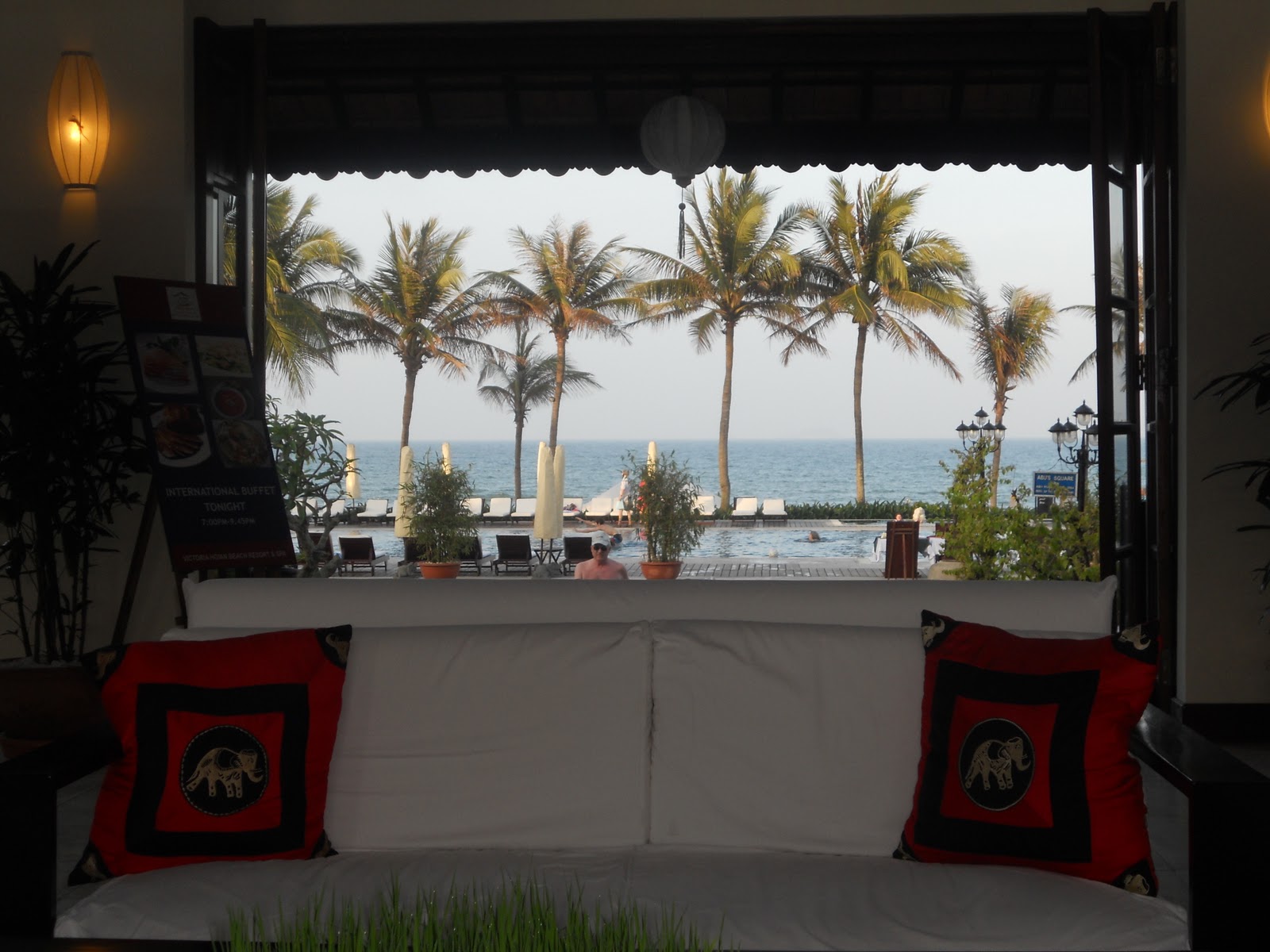
We drove through the Truong Son Mountain Range along the eastern coast from Hue to Hoi An marveling in the emerald green rice paddies.  The novelty of the number of motorbikes carrying five member families and everything from dogs to ducks on the back never wore off.  En route to Hoi An, we stopped at an American check point and dipped our toes in the South China Sea at the famous China Beach (site of American TV show in the 90’s).  Our guide Thin provided names of the best shops in Hoi An and even more importantly, a name of a cheap laundry service and left us on our own at the Victoria Hotel overlooking both the sea and river. 
After an afternoon filled with swimming in the South China Sea and a rice pancake lunch, we headed into the bustling city center of Hoi An.  Known for their multitude of excellent tailor shops, we chose Sun Tailors as our first destination.  With an option to choose designs from over twenty fashion catalogues or bring in your favorite article of clothing to replicate, the staff takes your measurements, helps you choose your fabric and guarantees your desired customized article of clothing to be delivered to your hotel within twenty four hours.  Wedding dresses,  work pants, swimsuits, pajamas, you name it! Although tempting, I had my eye on the shoemaker shop next door.  With over three hundred styles and several rings of leather choices, I fell in love with a pair of strappy sandals with pewter leather.  The woman outlined my foot on a piece of white printer paper, measured the circumference of my cankle (not ankle) and the arch of my foot and similarly guaranteed a delivery for the following evening, all for under $20.  The shoes arrived not only arrived on time, but in perfect condition and fit like a glove J
Although a shopping highlight, nothing could top the experience at the Lac Viet jewelry store.  I could only think of how much several of my girl friends would love this store, as you enter to find yourself in the middle of several tables of stacked Tiffany’s and Cartier catalogues.   Still can’t find your design? No worries, as the staff pulls out an I Pad from behind the counter to search jeweler websites .  Of all the options, I chose a rather boring yet practical pair of Tiffany silver ball earrings which cost $12 to have made.  Truly a store after a woman’s heart, they offer orders from the U.S. with shipping included! This will definitely not be my last shopping trip with Lac Viet.  The remainder of our time in Hoi An provided fantastic shopping , yet none would compare to this first night.
We developed perfect daily itineraries in Hoi An, as mornings were spent in three hour school sessions, followed by an afternoon on the beach to be concluded with nights strolling the beautiful lit of city.  To truly feel like a local, I sucked it up and even took a motorbike taxi into town one afternoon.  I almost killed the driver by suffocation, as I wrapped my arms around him for dear life.  At night we enjoyed delicious Vietnamese Cuisine including sautéed morning glory, Cau Lo pork noodles, pho noodle soup and more Dalat Premiere Wine!  The walks along the beautifully lantern lined streets and decorated store fronts provided a perfect post dinner show each and every night.  An absolutely beautiful area, I was sad to leave Hoi An yet anxious to arrive in Vietnam’s largest city, Ho Chi Minh City, formerly known as Saigon.

Friday, March 4, 2011

Vietnam: Ha Long Bay and Hue, February 23rd-27th

After several heavy hearted days in Hanoi, we graciously accepted the opportunity to enjoy the stunning scenery of Vietnam. After a four hour drive through the rice paddies and luscious green countryside of Vietnam, we arrived at Ha Long Bay. A UNESCO World Heritage Site, Ha Long Bay features thousands of limestone karst mountains emerging from the calm water. Our group didn't know much about the natural phenomenon, other than a cameo in an old James Bond movie. However, our three hour boat cruise provided superb boat spotting, a tour of a permanent fishing village in the water and a stop to explore million year old caves. Scientists claim the process of evolution created the hollowed out caves of stalagmites and stalagtites, while the Vietnamese believe the gods sent a family of dragons to defend the land from the invading Chinese and the caves were only remnants of their destruction. Even the nerdy science girl in me couldn't resist a good dragon story :)  Following the cave tours, the captain of our boat doubled as the chef and whipped up a scrumptious Vietnamese meal filled with spring rolls, pineapple, fried rice and shrimp.  The perfect outing could only be completed with an impromptu shopping session, as a woman from another boat appeared with boxes of fresh water pearl jewelry and postcards for sale.  Got to love an unexpected shopping moment!  Even with a four hour drive back, the sensory overload outside the window never got boring.  I don't know if there is much better than passing a motor scooter on the highway that is somehow balancing twenty ducks on the back. With a few pottery and weaving studio stops, we arrived back late at our hotel and hit the pillows!

After a incredibly successful school morning and a stop at Vietnam's version of a fast food restaurant, Pho 24, we headed to the airport.  We landed late at the Hue Airport, an old American air base used in the Vietnam War.  Hue was not only the capitol city of Vietnam under the Nguyen dynasty from 1802-1945, but also an important location during the deadly 1968 Tet Offensive Battles.  Our guide Thin picked us up the following morning for a full day of sight seeing.  Our first stop was at the Imperial City, a walled fortress and palace during the reign of the Nguyen Dynasty.  Surrounded by twenty meter thick walls, the Imperial City housed the Purple Forbidden City for Nguyen emperor's and their hundreds of concubines.  Unfortunately, both American and Viet Cong bombs destroyed over 60% of this enormous site and what remains shows the evidence of the war through thousands of bullet holes.  The only building that remained completely in tact from the war was the Emperor's library and spectacular theater.  The power of the arts and education....Although the site magnificent, the words and knowledge from our guide truly made this experience come to life. 

We journeyed through the relatively orderly (compared to Hanoi) streets of Hue before we arrived at the Pagoda of the Heavenly Lady.  The most famous Vietnamese pagoda, the Heavenly Lady is home to the famous 1963 Buddhist monk who lit himself on fire on the streets of Saigon in protest.  Many from that time will know the photograph, as it generated immense emotional response as one could see his frail body enveloped in flames.  I had learned his actions were to protest the war, yet in actuality he was protesting the religious persecution of Buddhists by the South Vietnamese President Diem.  Within the pagoda grounds, several pictures and belongings of the monk remain, including the blue car in the background of the famous picture. 

Following our tour of the pagoda, we ventured down to the Perfume River for a dragon boat ride.  The leisurelly stroll down the river provided views of family temples, cemeteries and many Vietnamese farming the beautiful land on the river banks.  Our boat tour concluded at the steps of Emperor Minh Mang's enormous tomb.  Built by his first son, this tomb consists of forty separate temples, thirty stone protective statues and sixty word carved stones with the emperor's favorite poems and words of wisdom! We returned to the hotel for an afternoon swim and a search for Vietnam fiction and nonfiction novels to continue my fascination and never ending desire knowledge on the history leading up to and during the Vietnam/American War.  Our night ended with a superb six course Vietnamese  meal, highlighted by the appetizer spring roll course designed in the shape of a peacock! Between devouring the peacock and my new found obsession with Vietnam's version of Two Buck Chuck wine (Dalat) the dinner was a definite highlight. 

For day two in Hue, we headed out for a little bit of a road trip.  Travelling along the Ho Chi Minh Trail, a complex set of foot and bike trails within the jungle used by the Viet Cong to transport people and war supplies, we passed multiple war cemeteries some with over 20,000 soldiers.  We reached the Khe San Air Base, the sight of a gruesome decoy battle in 1968 just days before the Tet Offensive.  The landing strips remain, as do several remnants of bombs, bunkers, a massive Chinook helicopter and a present day museum.  This moment began my two facial expressions for the majority of the day--my mouth open at the gruesome nature of pictures and stories told from the other side, or trying to brush away the unwanted tears that seemed to find their way to me today.  We left the air base to head towards the old DMZ at the 17th parallel.  Along the way, we passed the cleverly named Rock Pile, a large pile of rocks the Americans used to protectively watch the DMZ.  All that remains today at the 17th parallel is a small bamboo bridge over the natural boundary of the Ben Hai River with accompanying loud speakers used by both the North and the South.

We made our final stop at the Vinh Moc tunnels, a complex underground tunnel system built by the villagers to protect themselves from the American bombs.  Built in 1965, the tunnel complex measures of 2000 meters long with six entrances, a kitchen and rooms up to 30 meters below ground supplying "housing" for 60 families.  The tunnels are now open for tourists to walk through to experience the life of a Vinh Moc at that time.  Megan and the kids opted out immediately, as the small spaces with no ventilation did not appeal to them.  However, Tim and I walked through the pitch black tunnel system, amazed by the engineering and survival methods of this group of people.  I experienced quite a scare, for at one point I could hear loud, running footsteps approaching Tim and I in the bitch black.  My instincts kicked in and I stepped inside one of the family bunkers, scared as shit.  We laughed about it later, yet awful images and thoughts were going through my mind as it happened!

The journey home provided picturesque views of canoes with paddlers in conical hats traveling through rivers with rolling green hills in the background, untouched by the Vietnam War.  Such a beautiful country..

Friday, February 25, 2011

Vietnam: Hanoi , February 21st-23rd


Traffic in Hanoi
Taking into account the tragic history and stunning scenery, Vietnam has been a place I’ve been looking forward to this entire trip.  We flew from Kuala Lumpur to Hanoi, the capitol and second largest city of Vietnam.  As I handed the customs officer my passport, I could only wonder about his thoughts as he noticed the US flag on the cover.   I had no idea how the Vietnamese viewed Americans today and this was my first test.  The customs officer smiled at me, stamped my passport and I was at the baggage claim within seconds.  After a one hour drive from the airport, we arrived at the Sofitel Metripole Hotel, right in the heart of the old French quarter.  Many buildings remain from the French colonization (1859-1954), most of which have been restored into embassies, hotels and quaint shops.  After a quick freshening up, we hit the streets of Hanoi.  As I crossed my first street, I realized it would be a miracle if I left Hanoi with all limbs, ten fingers and ten toes.  The insanity of the traffic is like nothing I have ever seen in my entire life! Motor bikes and cars jostle for space on the two lane streets,--crossing into each others lane, continuously honking and not slowing down a bit for pedestrians.   You would think that the sidewalk would be your safe haven, yet motor bikes drive out of stores, alleys and onto the sidewalk to join you.  I poked my head into numerous silk and antique shops, but ultimately couldn’t resist the bargain of a $4 USD pedicure.  I splurged and opted for the $5 pedi with nail art, because if you don’t do it in Vietnam, when the hell will you?  
Hanoi streets
Following our nail salon excursion, we couldn’t wait any longer until we tried the Vietnamese famous pho—spicy chicken noodle soup.  Accompanied with Vietnamese pancakes and rice paper rolls, our first meal in Vietnam was a hit!  In order to clear our minds for the walk home, Megan and I downed a bottle of Vietnam rice wine.  Definitely the best solution, as a calm came about me as I crossed chaotic streets.  Day one in Hanoi was a definite success.
Ho Chi Minh Mausoleum
I awoke day two ready for a noodle breakfast and a day with our guide Long learning as much as humanly possible.  Our first stop was the Ho Chi Minh Mausoleum, an enormous complex to honor the controversial Ho Chi Minh.  Endearingly referred to as “Uncle Ho” by many Vietnamese, Ho Chi Minh was the founder of the Communist party, the person to declare independence in 1954 from both France and Japan and the first president of Vietnam.   Within the large granite structure inspired by Lenin’s mausoleum in Moscow, you walk into a dark room and your eyes are immediately drawn to Ho Chi Minh’s preserved body within a glass case, with dim lights shining on his face.  Russian experts were brought in after his 1969 death to preserve the body to boost the morale of the troops during the war.  The complex is intensely guarded by crisply white uniformed officers every few meters; many of which did not think highly of me, as my bag was searched multiple times and my arm grabbed in order to not stare at Ho Chi Minh’s body too long.  Megan was convinced they just liked to touch me, but I must say it was a bit unnerving!  Guards enforce people to walk in two silent lines, with hands straight down at their sides, in addition to covering any bare skin.
Presidential Palace
House on Stilts
Behind the mausoleum, lies the bold yellow Presidential Palace from the French rule of 1900-1945.   Vietnamese history and our guide informed us that Ho Chi Minh refused to live in this yellow montrocity due to its grandeur--opting to build a two room traditional house on stilts on the grounds next door.  Masses of people queued to get a look into HCM's humble abode and photograph his famous work space.  Following the HCM complex, we headed to the Temple of Literature, the first university of Hanoi built in 1070.  One of the few buildings that survived the war, the school's ornate decorations and respectful throne seat for the teacher left me thinking about the architecture designs in my future classrooms.  
With a jam packed morning, we were anxious for the Vietnamese "fish hotpot" lunch at Cha Ca La Vong.  As we sat down, our waiter brought us a laminated sheet of paper that read "1 DISH ONLY-FISH..AND BEER".  I like a place that makes your decision a little easier--so I graciously welcomed the famous Bia Hanoi beer to cut the burn of the fish hotpot dish! Absolutely delicious.  We walked off the excessive beer calories at the Museum of Ethnography, a conglomeration of artifacts from all fifty four of the ethnic minorities throughout Vietnam.  Fish baskets, ornately woven wedding gowns, Hmong houses, hundred year old pottery and more. 
We found ourselves standing outside the Hoa Lo Prison, known by many Americans sarcastically as the Hanoi Hilton due to the miserable conditions.  Originally built by the French to house Vietnamese political prisoners, it later provided the North Vietnamese a prison to house American prisoners of war.  Although much of the original prison is gone, a museum containing photographs and several original 5 foot x 3 foot cells remain, including John McCain's.  McCain was shot down in Truc Bach Lake in Hanoi and later transferred to Hoa Lo, where he was imprisoned for several years.  I am still formulating so many thoughts on the images I saw within these walls. 
Hanoi Hilton
After a day filled with new information and heavy emotional material, we winded down with a cycle taxi tour of Hanoi.  Well...we thought it would be a relaxing journey.  Instead, I found myself discussing my will with my bike partner, Sam.  With the absence of street lights and continual automobile/motor bike honking, I closed my eyes for the majority of the trip! I opted for a night of relaxing in the hotel room, googling my multitude of new questions on the Vietnam War and beginning to digest all that I had seen that day.

Wednesday, February 23, 2011

Malaysia: Langkawi and Kuala Lumpur, February 14th-21st

Firefly Airlines got us into the Malaysian beach resort island of Langkawi early and safely!  We trekked through rainforests and past monkeys, into the winding driveway of The Datai Hotel where we would be relaxing for the next five days.  Set within the depths of ancient rainforests and macaque monkeys, the Datai provided stunning beaches and pools to lounge and lose myself in several books.  With productive morning school sessions, the afternoons were left to play Monopoly, take a nap and frequent the water.  As if the scenery were not enough, we ate like kings and queens at both their Thai and Malaysian restaurants.  Although legends tell of Langkawi's pirate haven days, the island has truly turned into a beach paradise. 

Independence Square
Despite several days in paradise, our taxi driver had to literally drag us away from the idyllic setting and into the cab to make our flight to Kuala Lumpur, the capitol and largest city of Malaysia.  My city girl heart started beating as we entered the city limits of this shoppers haven and symbol of Malaysia's growing economic power.  Thankfully we stayed at a generous hotel, for there was not time to drop the bags in the room, with only a day and a half in KL, there was shopping to be done.  We didn't have to venture far, as we reached the Pavilion, one of KL's six shopping malls connected with one another.  I mixed amongst the locals at the Time Square Mall, with local markets on each of the twelve levels.  My night's entertainment could be found within a 3 block radius--TV commercials with cars on the side of buildings were being filmed, festivals with people break dancing to Glee and more Chinese New Years parties! The Petronas Tower's lights guided me back to the hotel in the wee hours, exhausted and already loving KL.

Chinatown Market
No doubt our full day in Kuala Lumpur would have to be jam packed to fit all of the beauty of the city.  After a first stop at the Malaysian's King Palace and National War Memorial, we visited the National Mosque of Malaysia.  With our styling purple robes, we toured the stunning complex and met many volunteers anxious to teach us more about their religion.  We finished our morning in the footsteps of the Malaysians that announced independence from Britain in 1957.  Now appropriately named Independence Square, this open park area surrounds itself with stunning buildings and crowds of people.  We spent our afternoon at the famous Petronas Towers, the tallest buildings in the world until the last two years.  The Sky Bridge on the 41st floor and the observation deck on the 86th provided never ending views of the growing metropolis.  Amongst every Asian cuisine option available for lunch, we devoured a Japanese meal incredibly happy to be back with tuna sashimi and shabu shabu.  I spent the rest of my Sunday afternoon walking through the local markets of Kuala Lumpur where handbags, sunglasses, watches, Batik dresses and more crowded the streets.  Being the only European in the thousands of locals I got everything from Britney Spears to Kim Kardashian to a headband fashion choice like Gaga.  Although no purchases, the entertainment was enough to last me hours.  Tomorrow I head to Vietnam, a country I have been looking forward to this entire trip!

Penang, Malaysia February 12th-13th

After leaving the mainland of Malaysia, we crossed a brand spankin' new bridge to the island of Penang, where it claims to have the best hawker food in the world.  The whole "hawker food" concept is a new one to me--the idea of picking a street corner or street and sampling dishes from a variety of stalls.  Definitely an experience that is good for the pocket books and taste buds :)

We pulled into the Eastern Oriental Hotel, an old British colonial building, and hit the streets to check out the city of Georgetown.  Little did we know that we were in town for the biggest party of the year, the Chinese New Year Festival Celebration!  Ringing in the year of the rabbit, over ten city blocks were closed down for Chinese children games (reciting Confucius sayings, making paper flowers, etc.), Recycle Fashion Shows with accompanying Madonna music (me with my favorite contestant in the picture), live rabbits, Chinese acrobat shows and numerous food stalls.  As we walked into the festival, a group of street performers displayed their skills in the national sport of Chingay--balancing a 30 foot bamboo flag pole on their heads only to "head it" back to their teammates to land on their chin! It makes the "Original Tin Man of Chicago" street performer look like a nobody!  After an evening of games and shows, we hit the food stalls.  The Midwest girl in me could not contain my excitement when I saw a corn pancakes sign! Absolutely delicious AND innovative! Delicious fried noodles, dumplings, and honey chrysanthemum tea followed, although tough to follow my opening dish.  I stood amidst the body to body crowd marvelling at the midnight fireworks.  What a party :)

It took several cups of coffee to get me moving the following morning for our city tour of Penang.  After a stop at Fort Cornwalis, we couldn't miss Cheung Fatt Tze's, the 19th century Chinese tycoon/player, Blue Mansion.  With a strikingly beautiful blue color, the mansion was built for his favorite wife (number 7) and offers great insight into Chinese architecture and the principles of feng shui.  A blue mansion could really only be followed by the Temple of Supreme Bliss (Kek Lok Si) and the Pagoda of 10,000 Buddhas the site did not disappoint.  Although the big tourist attractions were a hit, the real adventure came when we got to Gurney Drive, the longest and busiest hawker stall street in Penang.  Situated along the sea esplanade, Gurney Drive offered Malaysia's top dishes and of course, we had to try.  The char kway teow won my award--Chinese flat rice noodles fried with prawns, bean sprouts, sliced chilis and corn! By far, the largest stall was the International Satay Man--over 10 different kinds of meat being grilled right in front of your eyes.  With stained shirts and full tummies, we strolled down the Straits of Malacca until our bodies just couldn't take it anymore.  I collapsed in my bed, anxious for an early morning flight to the island of Langkawi.

Thursday, February 17, 2011

Malaysia: Malacca and the Cameron Highlands Feb. 9th-11th

With my mouth still burning from red chili crab for dinner and spicy nasi goreng for breakfast, I warned our driver that I may soon be breathing fire as we entered customs on our way into mainland Malaysia, the meeting point of the worlds of the West and East.  Just a short drive from Singapore, we passed through customs like a well oiled machine and began our journey to Malacca, a historically important city on the Straits of Malacca.  For centuries, dynasties battled for control of this port town, which is evident in the architectural and culinary influence of the Chinese, Indian, Portuguese, Dutch and British throughout the city today.  We dropped our bags at the Renaissance Hotel, put on another necessary coat of deodorant and went on a self guided tour of the city. We passed by many hotel recommended restaurants, but instead opted for the Portuguese Settlement--where the locals go! As we stepped out of the cab, a group bombarded our taxi to lure us to dine at their seafood stall.  Told by many that Seafood Stall #1 was the place to go, we bypassed the heavy talkers and found a table for 6.  The only Europeans in the crowd off 200ish people, many onlookers enjoyed our efforts at ordering in the "you pick it, we'll cook it style".  You literally go up and handpick the fish and crab you would like them to cook.  Must have been good ones, as we devoured black pepper crab, fried noodles, fresh grilled fish, spicy vegetables and more! Yum and yum!

Pick your seafood :)
Chinese New Year plate
Anxious to learn more about the history of Malacca, a guide joined us on day two.  It is evident that people from countries and religions all over the world have shared this land for centuries.  We walked along "Harmony Street" where ancient mosques, temples and churches are within doors of one another.  Jonker Street added the colonial character with quaint little shops and narrow alleys. Even government buildings and forts still stood from the Dutch and Portugueuse dating back 500 years.  A trip to Malacca isn't complete without a trishaw ride through town.  Quite possibly the coolest form of transportation worldwide, the trishaw is a bike taxi decorated with all the junk you could imagine, including techno music pumping at the highest possible volume out the back! What a sight.  We finished our day at Bistro 11, enjoying a fusion of Indian and Malaysian cuisine, topped off with a festive Chinese New Year dish to ring in the year of the rabbit.


The following morning we said goodbye to Malacca and started our drive inland.  Allowing us to see much more of this beautiful country, we drove through the Titiwangsa Mountains and into the Cameron Highlands.  With a much cooler climate than humid Malacca, our main destination were the British influenced tea plantations.  With the plantations carpeting the valley and snaking up the mountainside with a mysterious cloud sweeping in, my uncle Tim noted that it felt as if we were walking through a National Geographic article.  After a tour of the production factories, we all sat to take in the scenery with a steaming hot cup of BOH tea :) After a long travel day, the comfort of our Cameron Highlands Resort Hotel bath robe was just what I needed.